

The Hive is Buzzing

Ajit Banerjee
Prefer video? Watch the v0.4 discussion with Ryan, and Yucheng and Ajit.
On February 27th, I was reviewing agent friction logs when I saw this:
ox agent OxFxV0 query "Team discussion between Reza and Vikas about restaurant integration"
The ox agent query command did not exist in v0.2. The agent hallucinated it. But what struck me wasn't the hallucination — it was the intent. Claude wanted to search the team's discussion history. It assumed it could. It was right to assume it could. We just hadn't built it yet.
Seven days later, team context search shipped in v0.3. Three days after that, codebase search joined it in v0.4.
Desire Paths
The idea traces back to a conversation on February 18th between Ryan, Steve Yegge, and me. Steve had been writing about what he calls the Desire Paths approach to agent UX:
I have been curating Gas Town the same way I did Beads, using the Desire Paths approach to agent UX. You tell the agent what you want, watch closely what they try, and then implement the thing they tried. Make it real. Over and over. Until your tool works just the way agents believe it should work.
Ryan internalized this before we shipped Ox CLI v0.1. He built what we call the agent friction dashboard — a client-side system that logs every command an agent attempts, whether it exists or not. Hallucinated subcommands, misspelled flags, invented syntax — all captured.
We plan to break the friction tooling out as standalone libraries for others to embrace these Agent UX ideas — a form of PostHog for agent CLIs. But right now, our focus is taming the startup chaos in the hivemind. The classic information retrieval progression: collect, organize, index, distill. The friction dashboard is the collect step. Everything else follows.
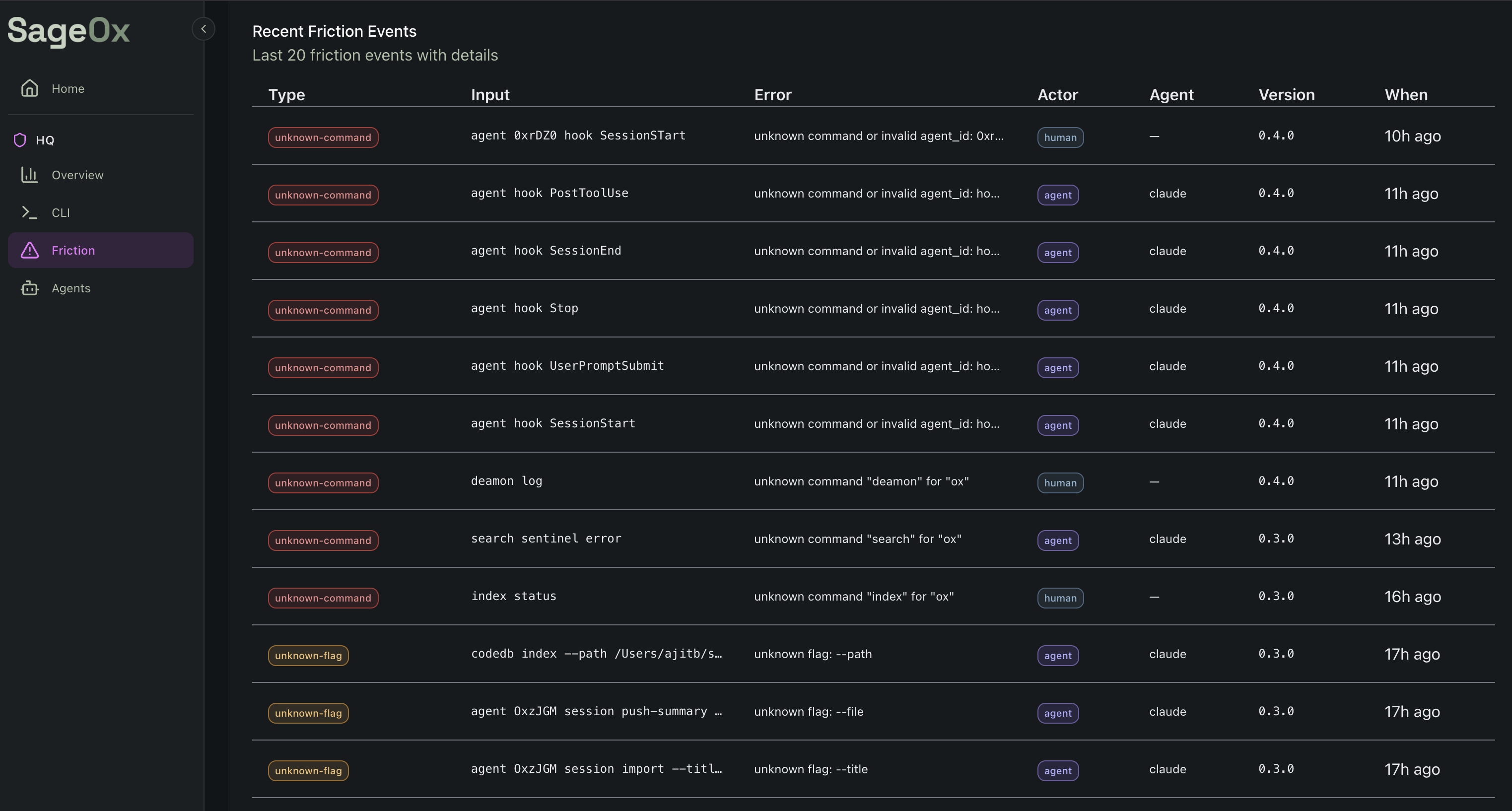
It captures the mental model that agents carry about how a tool should work. When Claude tries ox agent query, that's a signal. When Codex tries the same thing with different syntax, the signal gets stronger.
From Hallucination to v0.3
That hallucinated query command told us agents wanted to search the Team Context and the Ledger — the team's discussion history, decisions, and session records.
By March 6th, Ox CLI v0.3 shipped with team context search. The approach was classic information retrieval: BM25 for keyword precision plus vector search for semantic recall. Not because it was fashionable — because we ran the numbers.
I had coding agents work through a dozen retrieval strategies: managed RAG services, multiple embedding models, knowledge graphs, vector-only search. The agents executed the evaluations. But the choice — BM25 plus vector hybrid — was mine. Small embeddings fail on proper nouns. Managed RAG services lose precision on our corpus size. That's judgment, not intelligence.
Champagne and a Source Graph
On March 4th, Ryan and I met Dr. Yucheng Low at Tomo in White Center. Yakira got us champagne. The conversation wandered to a thought I'd been sitting on: it would be useful to have a source graph — a structured index of the codebase that agents could query alongside the team context.
Yucheng's response: "Let's just try it."
By Thursday night he had a working implementation. Claude wrote all the code. About $20 in extra API usage.
Yucheng didn't just prompt an agent and accept whatever came out. He has decades of experience in graph databases and distributed systems. He guided Claude through sensible architectural choices from the start — choices that would have taken weeks of wrong turns without that background. The agent was fast. Yucheng's judgment made it accurate.
I asked Dr. Rupak Majumdar — programming languages researcher, based in Germany — to review Yucheng's work and build a Go implementation. Rupak's codedb-go landed by March 7th. Same pattern: Claude wrote the code, Rupak's expertise in code analysis steered the decisions. I pulled both implementations into the Ox CLI on Sunday, and Ryan cut the v0.4 release on March 9th.
Dinner conversation to shipping feature. Five days. No PRD. No Linear ticket. No Notion doc. This code went from human-human conversations stored in the Team Context and human-agent sessions captured in the Ledger — straight to production. The traditional artifacts didn't exist because the system that replaces them is the product we're building.
Tiki-Taka
It's impossible to give individual credit when the team operates like this. The idea didn't belong to anyone. It sprang from the common brain pool — the hivemind — and moved through people the way a ball moves through Barcelona's 2011 midfield. Xavi to Iniesta to Messi. No one holds it long. Everyone touches it. The play is the thing.
You can think of SageOx as a self-evolving entity. The friction dashboard surfaces what agents want. Humans with judgment pick the next move. Agents build it. The hivemind records what happened and why. The next agent session starts with all of that context loaded. Closed loop. None of us can afford to care about credit at this pace of iteration. The only winner is the customer, who gets to see a blitz of features that no planning process could have produced.
Intelligence is Cheap. Judgment is Everything.
Steve's desire paths. Ryan's agent friction dashboard. Yucheng's source graph. Rupak's Go rewrite. My retrieval engine. In each case, the agent produced the code. In each case, a human with domain expertise chose the path.
Intelligence — the ability to generate plausible code — is abundant and getting cheaper by the month. Judgment — knowing which of the ten plausible approaches is actually right — is scarce and getting more valuable.
The friction dashboard isn't an intelligent system. It's a judgment amplifier. It surfaces the signals that matter and lets humans with taste decide what to build next.
The End of the Giant Repo
Steve made an observation during an earlier conversation that stuck with me. He talked about how monorepos at big companies — the ones with 10 million, 20 million lines — became comprehensible only to the humans who'd spent years navigating them. That institutional knowledge was the moat.
Agents are about to hit the same wall. Context windows are finite. A repo that's too large for an agent to hold in its head is a repo where the agent makes bad decisions. The same scaling problem that created the need for senior engineers at big companies is going to create the need for smaller, more numerous repos at fast-moving teams.
We think code is going to fragment. Not into chaos — into well-indexed, queryable modules sized for agent comprehension. The tooling to navigate across those modules — searching team context, querying code structure, understanding the why behind the what — becomes the critical infrastructure.
That's what Ox CLI v0.4 starts to deliver. A query layer that spans the team's collective memory and the codebase, running on a developer's laptop. No managed service. No cluster. An M-series Mac and the accumulated judgment of the team, encoded in the hivemind.
Want to see how we build? Signed-in SageOx users get a live view of the Ox CLI's development. feedback@sageox.ai